
Windows and Mirrors
Settling into Laos!

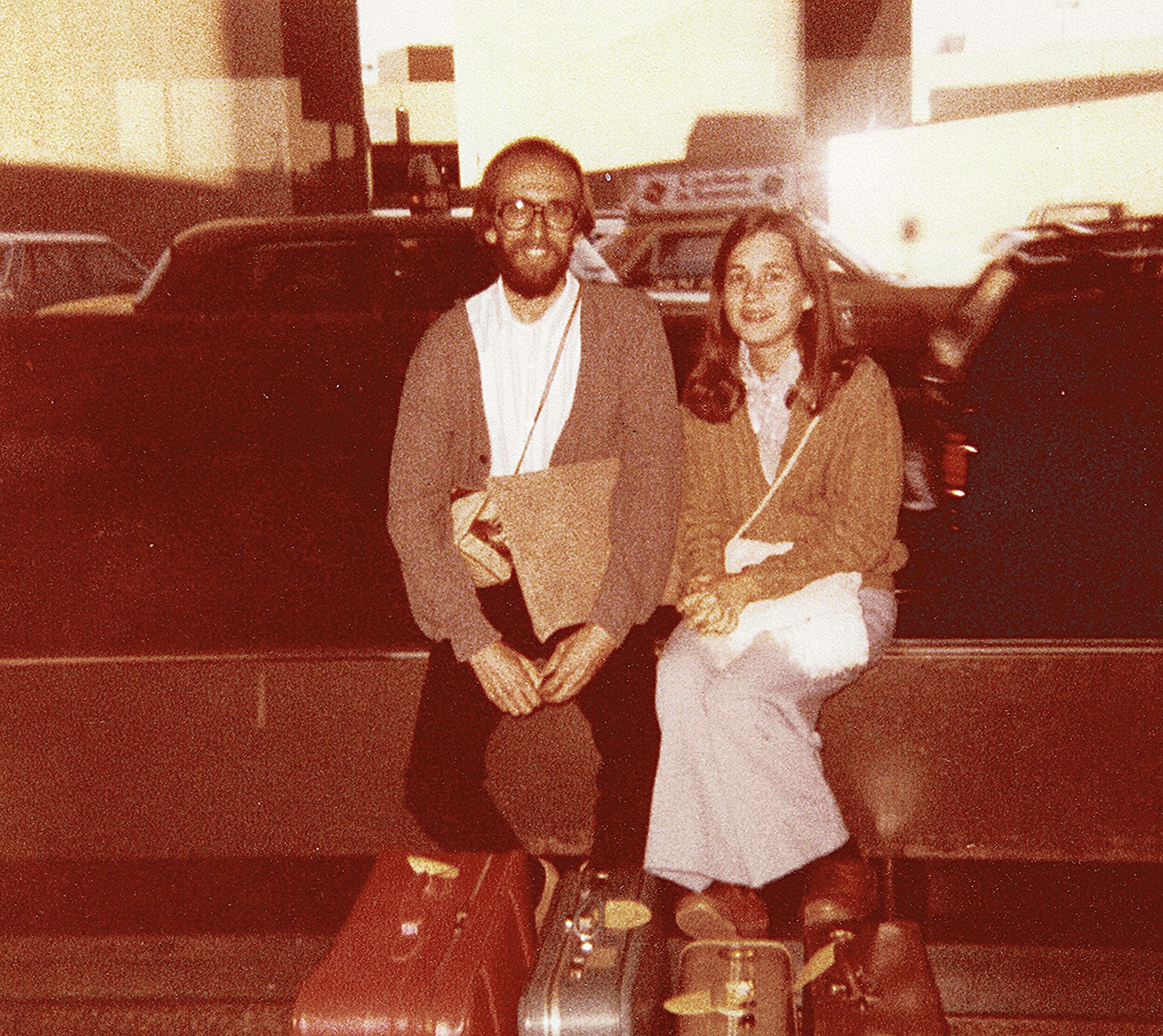
At JFK Airport in New York City, pretending to be ready for our first 3 years in Laos with Mennonite Central Committee! (September, 1980)
Six months after boarding our flight in New York we would finally arrive in Vientiane, ready for 3 years of work, learning and engagement with the people of Laos. Bangkok’s noise, congestion and frenetic activity were in stark contrast to what we encountered at Vientiane’s Wattay Airport. As we descended the steps from the airplane onto the tarmac, we stepped back into the natural world, greeted by the sound of hundreds of frogs merrily chirping in the grass along the runways. This natural atmosphere was true throughout the capital city as described in a letter to my mother.
Vientiane
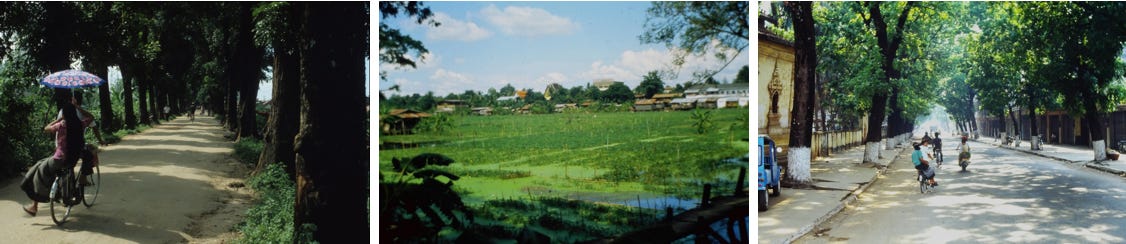
(Left) Kou Vieng Road was our daily path to the post office and morning market. (Middle) Phak Bong fields flourishing along Kou Vieng Road. (Right) Tree-lined street near the old Ministry of Foreign Affairs in Vientiane.
March 16, 1981: “When you think of us now…think of quiet things like bicycles, footsteps on a red dirt road, trees and grass growing, people watering gardens, buffalo plodding down the streets or a game of badminton. Or you can think of little noises like roosters crowing in the morning, cows mooing, children playing…birds chirping and some evening drums and music at the neighborhood Buddhist Temple.”
“Vientiane has a central market and business area that is shaped like a banana, following the curve of the river. Behind the central area is a collection of villages all rather loosely tied together to form Vientiane…There are occasional rice fields, banana groves or vegetable gardens scattered through…these villages.”
There was, however, a darker side to the quiet calm that enveloped the city. It had its roots in the loss and trauma of war which led to the exodus of 350,000 people from the country, along with businesses, capital and most international aid groups. Several years of drought and the poorly planned collectivization of agriculture led to real economic hardship and a feeling of stagnation. In addition, many former military and high ranking government officials fled, fearing retribution.
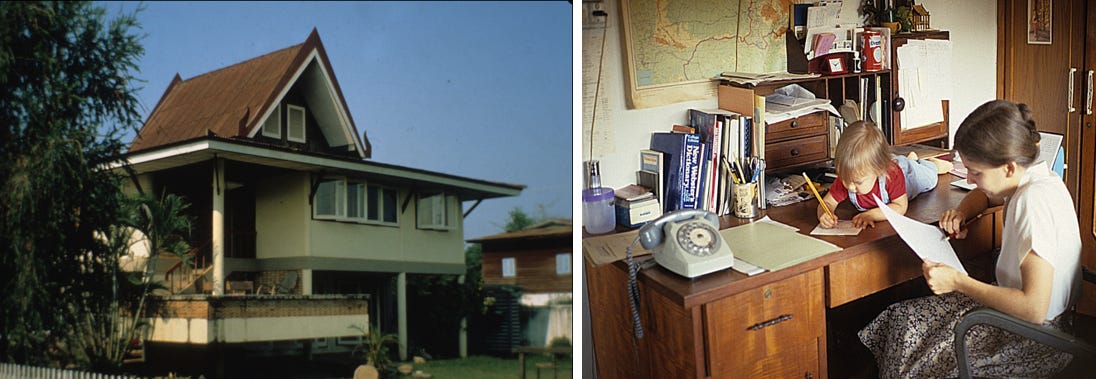
The MCC house/office in Ban Sala Daeng, Vientiane Linda in our office with daughter Beth.
Our Mennonite Central Committee (MCC) house/office was a cement house with hardwood floors, running water and electricity supplied by a large hydroelectric dam located 90 kilometers north of the city. We were located in a quiet neighborhood on a dirt street about a 5-minute motorcycle ride from the post office and morning market.
Relationship to the Lao Government
Unlike most other countries where MCC works through local churches and faith-based agencies, our partner in Laos was the Lao Government. In these early years of communist administration, there were no Lao non-governmental organizations with which to partner. During the war the current Lao Government leaders had lived in the caves of Vieng Xai in northeastern Laos to escape 9 years of U.S. bombing (1964-1973). This MCC-Lao Government partnership was a most unusual partnership for both parties and given the differing political and religious foundations that we represented, one that stretched us both.
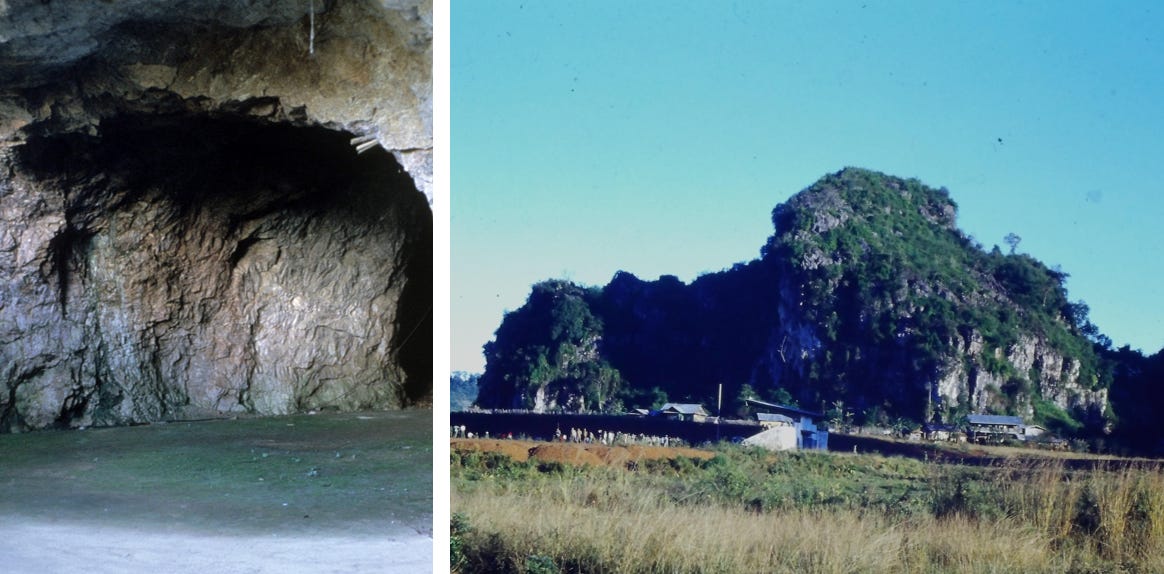
The cliffs and caves of Vieng Xai, Houa Phan Province Laos sheltered Lao leaders and villagers during the U.S. air war 1964-1973. Photos (1981) by Titus Peachey
Of the 3 Indochinese countries (Vietnam, Laos and Cambodia) that had recently emerged from wars with the U.S., Laos is the only country that did not sever diplomatic ties with the U.S. While the vast majority of U.S. government and voluntary agencies had left Laos in advance of the communist takeover, a small staff of 6-7 U.S. citizens was allowed to remain at the embassy. Not surprisingly, there were real political tensions between the U.S. and Lao governments. Perhaps the relationship could best be described as distant or cold. These 45+ years later, I still wonder what political calculations or connections on both sides allowed U.S. diplomats to remain after such a devastating war.
Very Small U.S./American Community
Remarkably, in addition to the small U.S. embassy staff, there were two Quakers (American Friends Service Committee) and two MCC workers resident in Laos in early 1981, comprising a total of 10-12 U.S. citizens in the entire country. During the first year in Laos, MCC’s relationship with the government was sometimes strained, but MCC’s identity as a peace organization that had opposed the war seemed to gain the government’s confidence in our presence.
Our immediate MCC predecessors (Fred and Jan) introduced us to a network of government officials and associates in the international community who would become our colleagues during our years in Laos. This included a small group of United Nations aid workers comprised mostly of European staff, a few import/export businesses, an Australian aid program and an assortment of western embassies. At dinners, receptions and national day celebrations we joined a community of people whose worldwide experiences made for fascinating conversations. However, the most visible foreign presence was likely from the Soviet Union. Indeed, as we rode around town on our motorcycle and bicycle the children would point and say, “Soviet! Soviet!” In this context we were a bit odd, and we had to get used to explaining our identity.
At one point during our time in Laos we met a Soviet journalist who was trying to figure out who we were. Realizing that we were private U.S. citizens working in Laos who spoke openly against the U.S. air war in Laos and, at that time, our government’s failure to clean up the unexploded bombs,[1] he was genuinely perplexed. “Very interesting,” he said. He had put his finger on something that would not be possible in the Soviet system. The contrast in our systems helped me to appreciate the right to oppose our government’s policy while at the same time valuing the constitution that protected our right to do so. In our current political climate this protection of free speech seems more and more tenuous. I was always glad, in Laos, to be able to say that our funding came from Mennonites in the U.S. and Canada, and not from the U.S. government. There is an important role for bilateral relationships between governments, but we wanted to keep our voice and identity clear, emphasizing the people-to-people character of our relationship with Laos.
Lao Friends
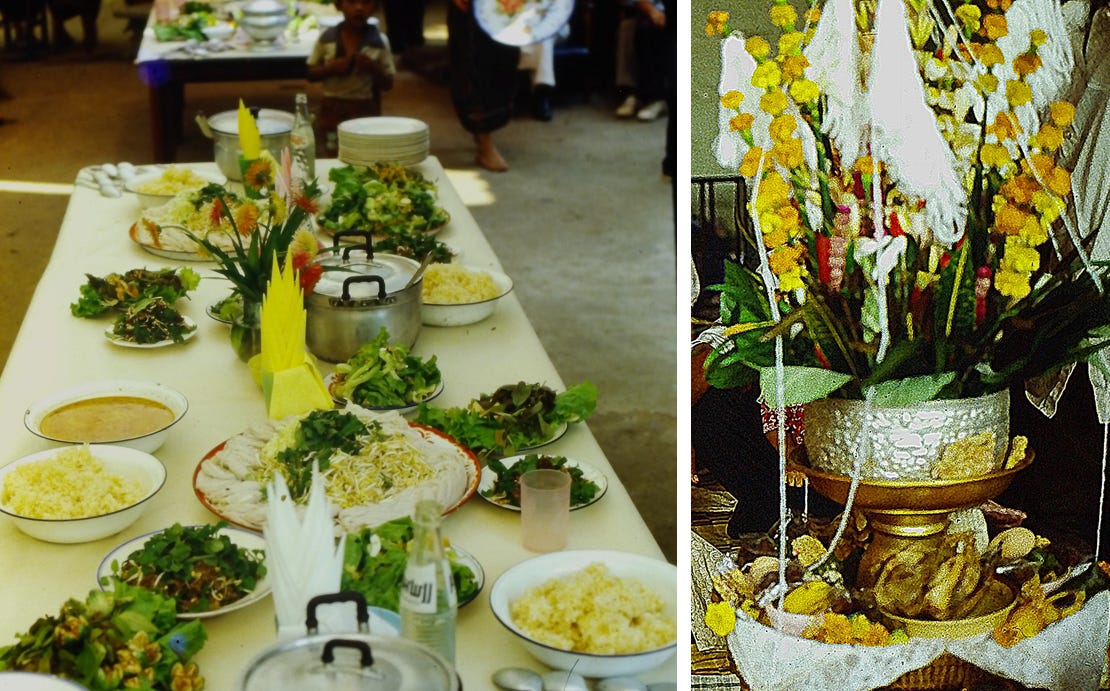
Family celebration at Somphane’s house with food and a colorful “tree” for the baci celebration of blessing. Photo by Titus Peachey
While we recognized our foreign status and the value of our connections to the international community, we were determined to become “rooted in Lao soil.” In this regard, we benefitted greatly from our relationships with Lao employees and their families. These included Somphane (1981-1985), our part-time housekeeper, Boun Nyu and Meo (1981-1983), our language tutors, and Hien (1984-1985), our program assistant. These dear people were not only a great help to us in our MCC role, but warmly welcomed us into their family events and holiday celebrations, giving us valuable insights into Lao culture and traditions. Somphane, Boun Nyu and Linda all gave birth during our time in Laos which allowed us to learn about Lao birthing traditions and the warm baci ceremonies of blessing that accompanied major life events. Somphane was an organized, efficient worker who blessed us with delicious food and answered our many questions about life in Vientiane.
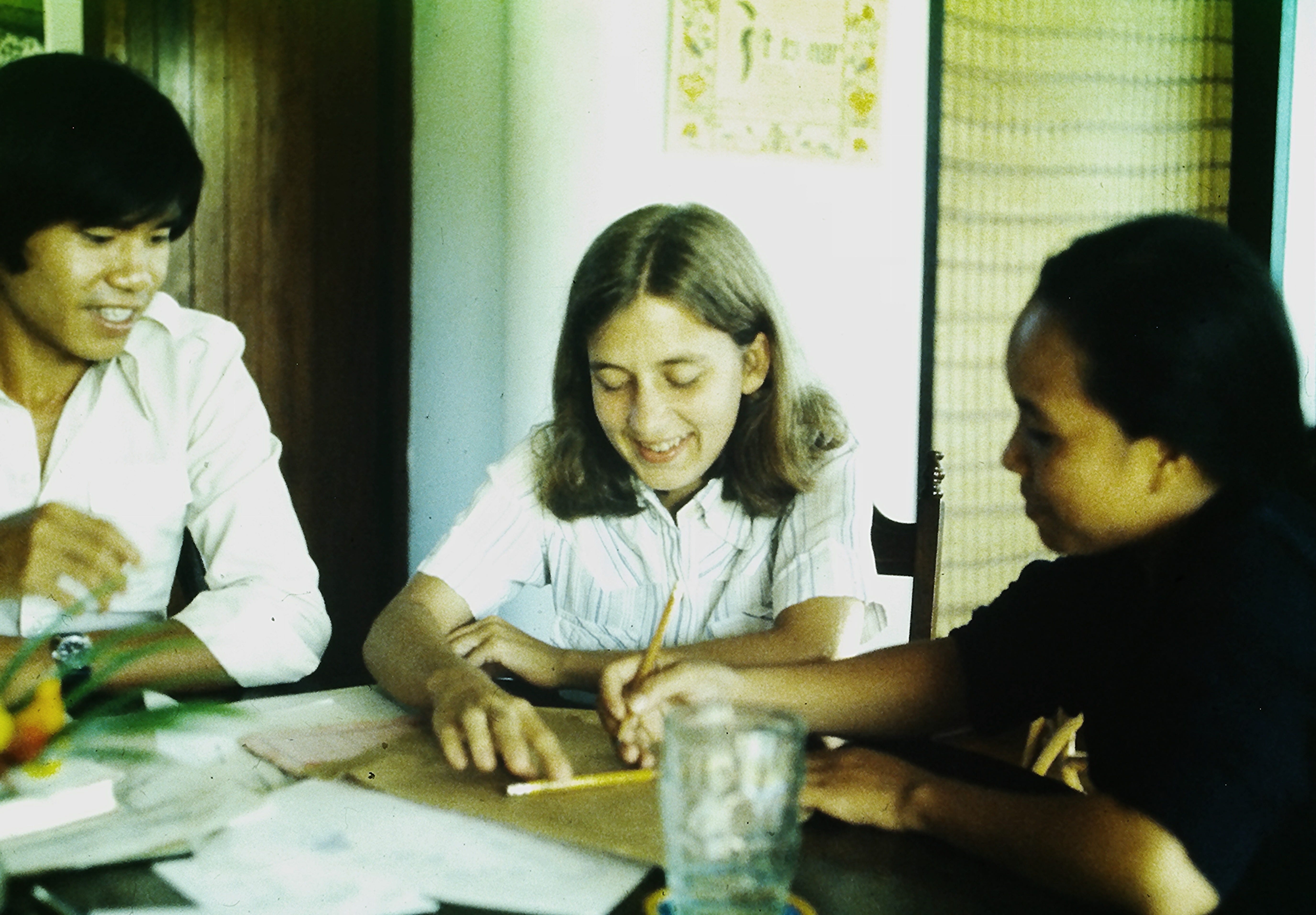
Our language tutors Meo (left) and his wife Boun Nyu (right) with Linda (center) in our house.
Our language tutors, a husband/wife team of medical students helped us learn about traditional understandings of health in Laos and the challenges of the health care system. We often enjoyed an evening meal together and had fascinating conversations comparing stories of Buddha and Jesus, as well as our understanding of peace and nonviolence from our faith perspective. They introduced us to Lao folk tales, including the stories of Xieng Mieng, the Lao peasant who always outwitted the King. It was biting social commentary through humor.
Hien, our program assistant spoke Lao, Vietnamese, French and English and helped us greatly in our work. Her warm ability to relate to villagers and government officials alike helped us untie bureaucratic knots and keep the work moving forward. After our daughter Beth was born and Linda was able to travel again, Hien and Linda took numerous work trips to other provinces, sometimes several weeks in length.
Another set of informal relationships was with the Lao Evangelical Church, a small group of 40-50 worshippers who gathered each Sunday morning. We attended regularly, solely on a personal basis, rather than any official partnership. Indeed the first MCC workers in Laos were asked not to attend because the church leaders wanted the government to understand that the church was Lao and not a Western implant. Under the former regime, U.S. missionaries gave strong support to the Lao Evangelical Church and some of the missionaries had fully supported the U.S. military intervention in the country. This put the church in a precarious position after the change of government in 1975.
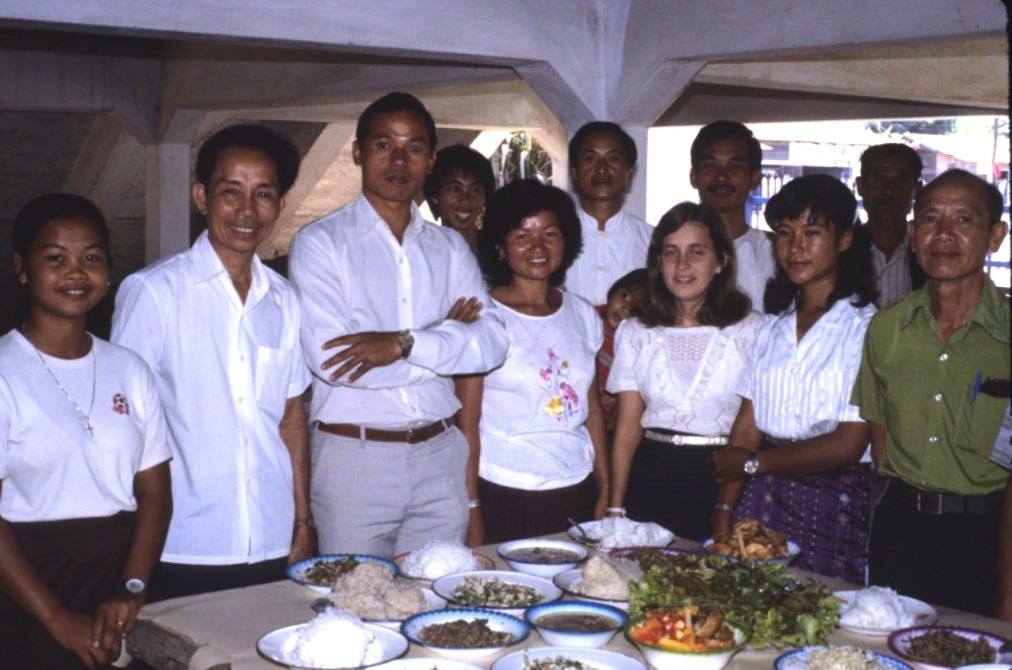
A meal at the Lao Evangelical Church during one of our last Sundays in Laos. Photo by Titus Peachey (1985).
By the time we arrived, tensions had relaxed to the point that church leaders encouraged us to attend. They were also pleased that we represented ourselves to the government as a Christian organization that provided aid to all people in Laos. They felt this helped to boost their own credibility with the government. One of the pastors had been studying at a Bible School in Thailand in 1975 when refugees were moving out of Laos in large numbers. During that very tumultuous time, he made the decision to return to Laos. We were inspired by his determination to “let his light shine” in Laos and by his ability to make biblical teaching relevant to the Lao context.
After saying goodbye to Fred and Jan, the Quakers became our go-to people for questions. Quaker reps Jacqui and Roger had been in Laos for several years, so we relied on their knowledge of how the aid relationship worked, particularly in those early months.
Connections by Mail and Phone
Communication with the MCC offices in Pennsylvania was by letter. Those exchanges could take weeks. On one occasion we received a letter from Washington D.C. that had taken a whole month to reach us. U.S. postal workers apparently didn’t know where Laos was, as we noticed a Dominican Republic postal mark on the envelope, along with the word “China” scrawled at another spot on the envelope! We recommended that our family write “via Bangkok” under our address to help guide our letters to us. Later in our time we received our mail, courtesy of a UN pouch delivered from Bangkok once a week. How we looked forward to mail day!
International phone service was non-existent. We could make calls within Vientiane City, and we could place a call to MCC in Bangkok via a telephone exchange. But when one of us went traveling to another province, there was no communication possible.
And so we settled into life and work in Laos, fully aware that we had much to learn. Within our first six weeks, we each took a trip to another province. These trips were language laboratories, history lessons, cultural explorations, political classes, studies in development aid and lessons in patience and trust all rolled into a 1-3 week excursion. These trips and the people we met along the way will be the subject of many future posts.
[1] Thankfully, as I will attest in future blog posts, this is no longer the case, The U.S. has become a major funder of bomb clearance and victim assistance in Laos.
You had the best experience and met the best people there, and I'm glad your time was so fruitful.
Oops… I just wanted to say how interesting this post and your previous one on your time in Laos has been. I am so impressed that you were not content with your first Asian country, and jumped with full enthusiasm into a second, learning the language, of course, and trying hard to familiarize with yourself with the culture. Also, I am guessing it was a startlingly serious way too bonded with your new spouse. A lot of of what you describe. Seems very similar toQuang Ngai. In 1972. well, I look forward to reading.